Triple E is Me!
Technology in Education
 |
| Photo Credit |
When I was student teaching I had a SMART board in my classroom and soon came to love everything about the board. All the different features, how you can easily change images from big to small to show congruent shapes, how the students can physically interact with it, blew my mind! My students loved it and I realized that I could probably never teach without the board again. I then entered into my current position where I did not have a SMART board and came to realize I still need to find a way to make students engaged. I needed colorful anchor charts, pictures, videos that could be display on an over head. It was much more time consuming, but the students were still engaged. After some I noticed that my students needed me to keep adding more and more to my lessons to keep them engaged so to me that meant creating and creating.
Triple E
The Triple E framework allows me to keep the students engaged by involving technology, but focuses more on the learning goals. The framework encourages teachers to look at the outcome of the lesson and if the students actually grasped the topic and not were just engaged of the movement on the screen. Triple E is not intended to teach the lesson rather helps bring the content in a different and interesting way.
"The framework was designed for educators to easily evaluate how to select tools to meet their learning goals, and ultimate design learning experiences so the tools have a positive impact on student achievement and learning outcomes."-Triple E Framework website
3 Components
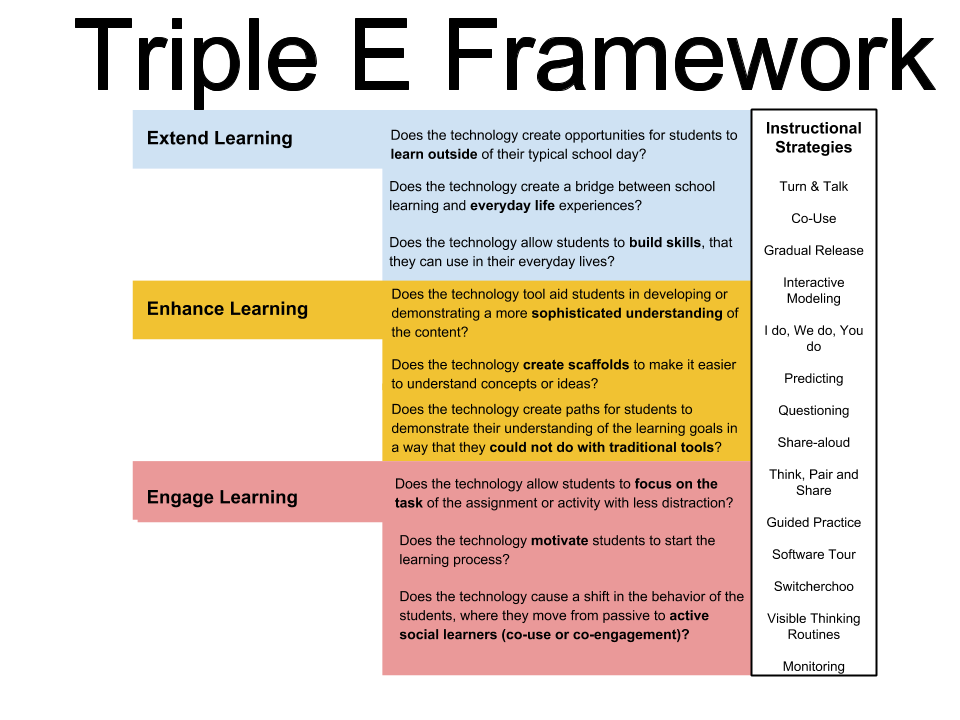
There are three components to the Triple E framework.
- Engagement in learning tools
- Its important to remember that engagement is them not just excited about whats on the screen, but are they actively interested in the content.
- Enhancement of learning goals
- This is more than engagement this is where the tool of technology can help aid, assist, scaffolding the learning where it becomes personalized to the learner.
- Extension of learning goals
- This is where you can extend the lesson to real-world connections and help students develop grit
Below is a list of questions you should ask yourself when creating lessons.
 |
| Photo Credit |
Why is the Triple 3 Me?
I knew the Three E was me when I first watched a video under the blog on the Triple E website. This was a great and simplex way the teacher was able to help students visualize. I never thought about using a laptop to help me teacher skills during guided reading. Whenever I thought about using technology, it was always more about the whole group lesson. This is such an easy way to integrated technology effectively into the lesson. Now I have never used this framework before in dept (following through and evaluating the lesson), but I have used this to google things on my phone when a student can't picture what the word is (hammock, stalk of corn, Indian, etc) I plan to do follow the complete process in upcoming lessons.
They did not understand that a little candy wrapper thrown on the ground here in Chicago can travel anywhere in the world by wind. The students we shocked that this could happen to an animal. We talked about ways here the students could save the animals. The students then wrote about ways they can help save the world.
I rated myself a 13 out of 18. I do feel the video and the photo helped students realize that they can make a difference in the world, but it is really hard to know if they will continue to practice these choices in their every day life. I do believe my students were engaged and active participants in the lesson. Many students came up with other ways they can save the earth like planting more trees. I think the students could have learned this from reading an article from a book, but I do not think they would have had the focus that they did.
Lesson Example
I did not think about the Triple 3 when I was creating this activity, but I used technology in the lesson and I am using the rubric to score it. My lesson was centered around Earth day and why it is important to keep our Earth clean. I've always recycled in the classroom and told students things that we can recycle, but they are kids and sometimes have no control over if they can recycle at home or not. I decided I wanted to help the students realize that they too can help save the earth. I found a video center on how kids can save water to help save the earth. It was a cartoon video so the students were really engaged. The video showed the students simple ways like turning off the water when they brush their teeth, taking shorter showers, using a little pool instead of a sprinkler. Students really caught on to ways that they could help the Earth. I think showed this photo. I first asked them how they thought this happened?
 |
| Photo Credit |
 |
| Personal Photo |
I rated myself a 13 out of 18. I do feel the video and the photo helped students realize that they can make a difference in the world, but it is really hard to know if they will continue to practice these choices in their every day life. I do believe my students were engaged and active participants in the lesson. Many students came up with other ways they can save the earth like planting more trees. I think the students could have learned this from reading an article from a book, but I do not think they would have had the focus that they did.


Amanda, think about a lesson you taught recently that involved technology. Using the Triple E scoring system can you give it a score and talk about why it received that score?
ReplyDeleteAdded a section for a lesson.
DeleteThanks! The addition helped me understand where you stand with the Triple E framework.
DeleteAmanda, I really like that you included the rubric for the Triple E Framework. Before learning about the different frameworks, I was nervous on what type of technology I would incorporate in my lessons, and if I did would I be using it effectively. This framework gives good insight on the learning outcomes you want to see in your students when incorporating any kind of technology in the classroom. I think it's is a good starting point for a new teacher trying to use technology for learning because it gives clear guidelines/outcomes that makes technology less intimidating and will build the teacher's confidence when implementing the technology. I know that it made me less nervous knowing I have something concrete to judge it against and evaluate the outcomes!
ReplyDeleteAmanda,
ReplyDeleteI found it interesting that your anticipatory set included the photo of the whale and you let your students take the lead on what they thought could have happened. Having our students visualize is often what it takes to allow them to engage with the material. Having them read a passage often does not let them connect with it in a meaningful way. I think this is why Triple E can be really helpful for a lot of Educators. Picking the tools that will help our kiddos reach the curriculum is what it's all about.
Thanks!
Amanda,
ReplyDeleteI was debating between using the Triple E Framework and the TPAK framework for my blog post! I was still leaning a little towards the TPAK framework but by you posting the Triple E Framework, I came to recognize a few of the strategies I use in my classroom too! Such as: "turn and talk," "I do, we do, you do" as well as "questioning" after all, you are a teacher like me and questioning and discussion techniques are a huge part of the Danielson Model and our evaluations! Do you use any of those following techniques and if so, can you give me any pointers? :)
Sarah,
ReplyDeleteI do use "turn and talk" and "I do, we do, you do". I use "I do, we do, you do" so much more. I use this more because my students often struggle with communicating their ideas. Most of the time, they do not understand what it means to discuss the story with a partner. I like using "I do, we do, you do" because its a model and they can observe me doing it, they have practice to do it with me and then on their own.
Amanda
Amanda,
ReplyDeleteI also was considering the triple E framework when first analyzing this blog entry. I believe that you can make a strong argument that this is a fluid and versatile strategy to focus on learning goals and outcome of the lesson. Ensuring that students "grasp" the topic is key and this framework will definitely ensure this. I am excited to see the applications you create using this frame work in the future!
Chris
Hi Amanda - Triple E is me as well! I understand what you are saying about the smart board. We use it as well in the early childhood class and the kids love it! It is good for them to be able to physically interact with! I also like how you were able to come up with other tools. With the little ones the specific technology matters less than the teacher and content and I like how you found other ways to convey your ideas. I also like your idea for the lesson and having self directed learning.
ReplyDelete